


Ukraine’s long-range drone campaign struck an oil depot in Russia’s Krasnodar region early Tuesday and targeted Moscow’s largest oil refinery, as mounting attacks continue to deepen Russia’s fuel supply crisis and pressure its energy infrastructure.
A drone attack sparked a fire at an oil depot in Russia’s Krasnodar region in the early hours of Tuesday, Russian regional authorities said, as Ukraine continues its “oil sanctions” campaign against Moscow’s fuel and logistics infrastructure.
JOIN US ON TELEGRAM
Follow our coverage of the war on the @Kyivpost_official.
According to the operational headquarters of Russia’s Krasnodar region, falling drone debris caused a fire at an oil depot in the village of Poltavskaya, in the Krasnoarmeysky district.
“Due to the fall of UAV debris, a fire broke out at an oil depot in the village of Poltavskaya, Krasnoarmeysky district,” the headquarters said.
Russian officials routinely describe such incidents as fires caused by “falling drone debris,” a formulation that avoids acknowledging that the facility itself may have been directly hit.
A road between the village of Poltavskaya and the hamlet of Trudobelikovsky was closed following the drone attack, the regional headquarters added.
According to Russian media, the Poltavskaya oil depot receives fuel from refineries, including Lukoil facilities, and redistributes it to gas station networks across Krasnodar Krai and Adygea.
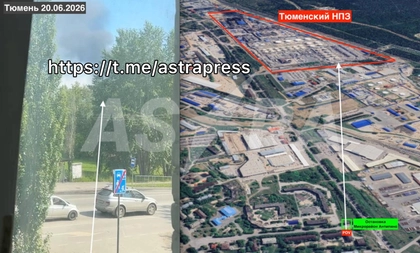
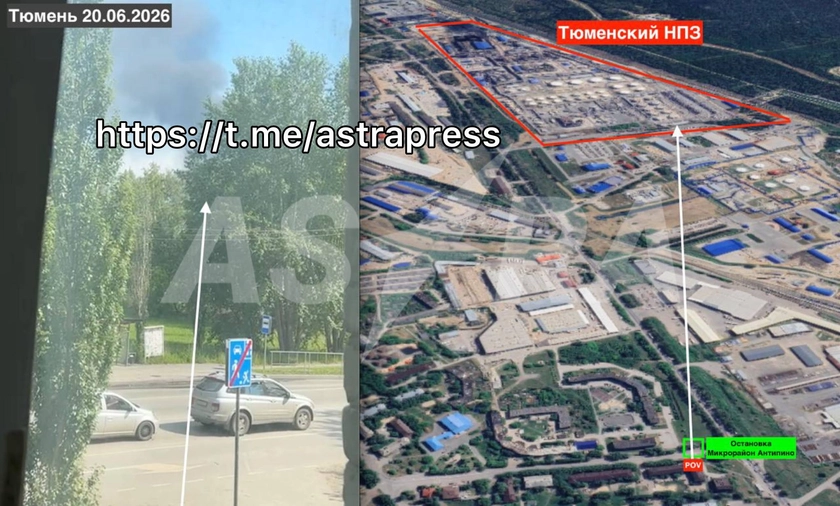
Drones Target Tyumen Oil Refinery Deep Inside Russia
The village of Poltavskaya lies about 80 kilometers (50 miles) west of Krasnodar, between the regional capital and the Sea of Azov coast, approximately 385 kilometers (239 miles) from the front line.
Krasnodar Krai has been facing gasoline shortages since early June, particularly following developments in the occupied Crimea.
Regional emergency officials said more than 500 gas stations are currently out of fuel, forcing many operators to purchase small wholesale volumes without long-term supply contracts. Russian media also reported shortages at major gas station chains due to a sharp spike in demand.
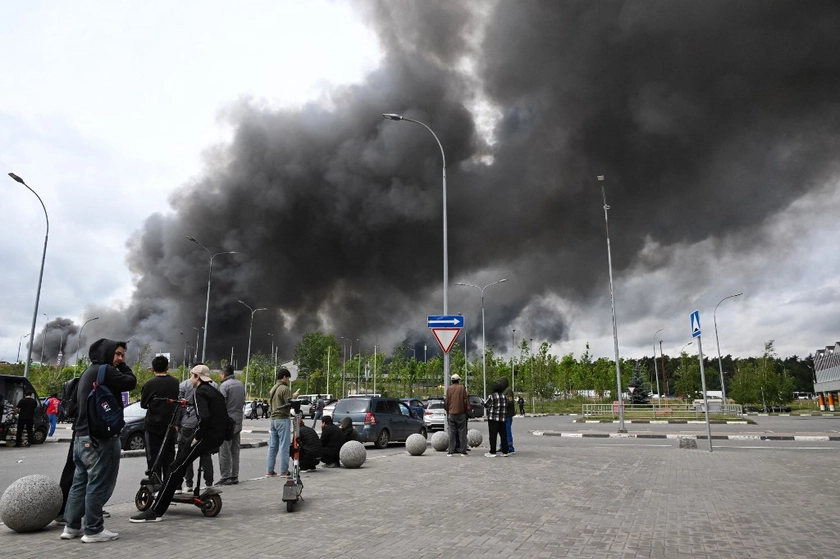
Meanwhile, independent Russian outlet Astra reported a large-scale drone attack on Moscow.
Moscow Mayor Sergei Sobyanin initially said 35 drones flying toward the capital had been shot down within two hours, indicating air defense activity over the Moscow region after 5 a.m.
Without specifying exact locations, Sobyanin reported drone interceptions 7 times in several hours, including 12 UAVs “flying toward Moscow.”
Eyewitnesses reported air defense activity in Pavlovsky Posad, Ramenskoye, and Zhukovsky near Moscow. One drone was reportedly shot down over Pavlovsky Posad.
Sobyanin later said another 25 drones heading toward Moscow had been intercepted.
At 7:37 a.m., the Ukrainian Telegram monitoring channel Exilenova+ reported that Moscow was under drone attack and published videos allegedly showing strikes.
The channel claimed “Lyutyi” drones were participating in the raid and noted that despite dozens of UAVs in the sky, no air raid sirens were activated.
The development of the Lyutyi drone was first publicly announced by Ukrainian state defense firm Ukroboronprom in October 2022. The company said it was developing a strike drone weighing over 200 kilograms (440 pounds), carrying a 75-kilogram (165-pound) warhead, with a range exceeding 1,000 kilometers (625 miles).
A Ukrainian government source involved in the project told journalists the Lyutyi is a unique analogue of the Iranian-made Shahed kamikaze drone, featuring high resistance to jamming and the ability to adjust altitude during flight based on terrain.
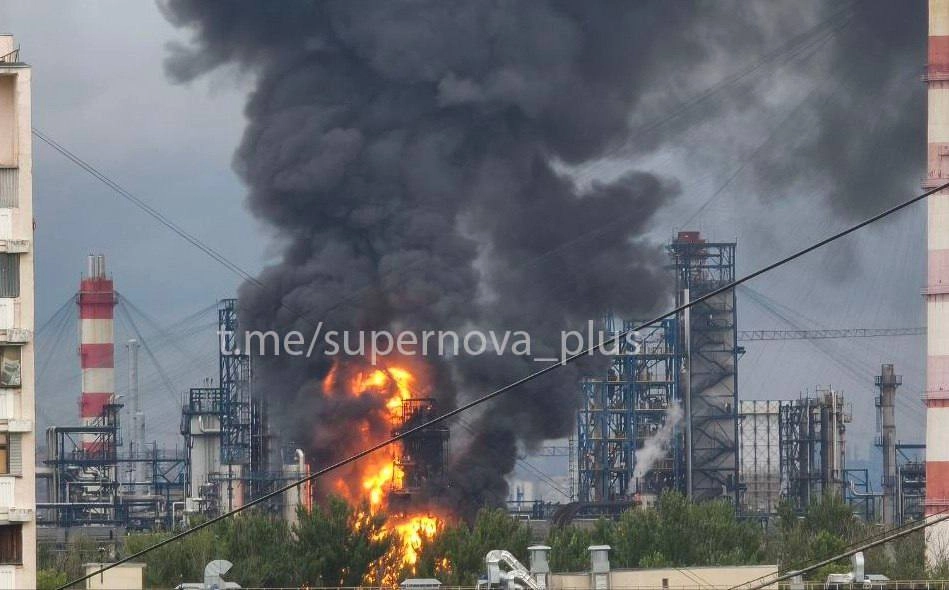
By 8:04 a.m., the channel posted: “Moscow’s largest oil refinery. Kapotnya. The hit is recorded!”
Monitors later claimed the refinery, described as heavily protected by dense air defense systems, was on fire.
Located just 15 kilometers (9 miles) from the Kremlin, the Moscow Oil Refinery (MNPZ), owned by Gazprom Neft, supplies up to 40% of Moscow’s fuel market and around 70% of gasoline consumed in Moscow and the surrounding region.


According to Exilenova+’s OSINT analysis, the refinery’s AVT-6 ELOU unit – described as the heart of the facility – was burning.
Later, Sobyanin confirmed that a drone strike had damaged the Moscow Oil Refinery in Kapotnya.
“Over the past 24 hours, enemy drone attacks on Moscow have continued. One of the drones damaged a facility at the Moscow Oil Refinery. There were no casualties. Emergency services are working at the scene,” the mayor said.
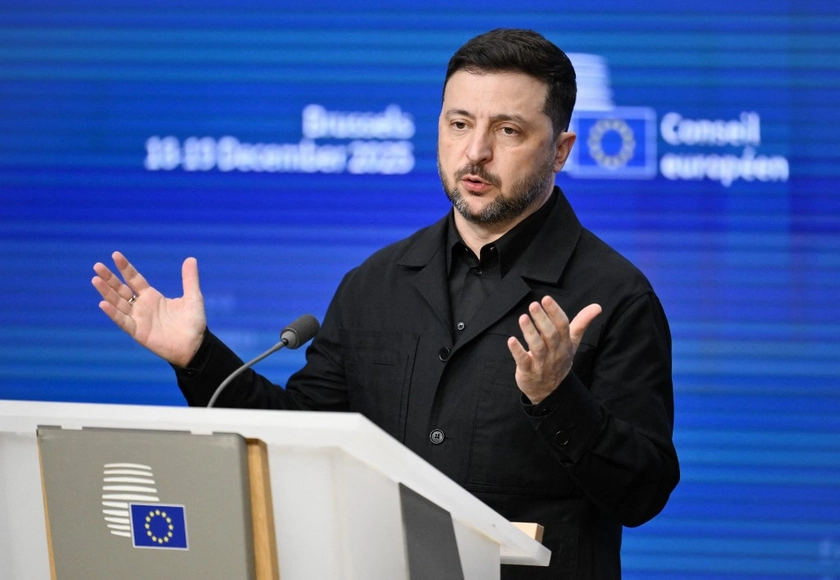
President Volodymyr Zelensky commented on the strike on the Moscow Oil Refinery, writing on social media:
“Ukrainian long-range capabilities were once again demonstrated in the Moscow region. An oil refinery located 500 kilometers away was damaged.”
Zelensky praised Ukraine’s Defense Forces for their effective work, adding that Russia must continue to be pressured until its war against the Ukrainian people is brought to an end.
“Ukraine’s long-range weapons are among the most important tools for achieving this. This is a fair response to Russian attacks and proof that the war must be brought to an end.”
Ukraine’s General Staff later confirmed damage to the Moscow Refinery in its report.
“Early on the morning of June 16, units of the Defense Forces of Ukraine struck the Moscow Refinery in Russia’s Moscow region,” the report said.
According to preliminary information, the ELOU AVT-6 primary oil processing unit was damaged, and a fire was recorded at the site.
“The Moscow Refinery is involved in supplying the occupying army. The company’s products account for more than 38% of fuel consumption in the capital region. In particular, the plant supplies aviation fuel to Domodedovo, Vnukovo, Sheremetyevo, and Zhukovsky airports,” the General Staff added.
At the same time, the refinery’s processing capacity exceeds 12 million tons of oil per year.
It is also worth noting that Russia’s Ministry of Emergency Situations stated that the fire at the Moscow Refinery was fully extinguished and did not affect the plant’s operations.
In addition, the General Staff confirmed a strike on the Russian military-industrial enterprise JSC Central Design Bureau of Apparatus Building near the city of Tula. The facility specializes in the development and production of radar systems and radio navigation equipment.
According to the report, the building and supporting structure of the assembly workshop were damaged.
The General Staff also reported that, as of 6 a.m. on Tuesday, a fire was still burning at the federal state-owned enterprise Temp Combine in Rybinsk, Yaroslavl region, following a strike carried out on June 14.
“The Defense Forces of Ukraine will continue systematic measures to force the Russian Federation to stop its armed aggression against Ukraine,” the report added.
Russia’s broader fuel situation is deteriorating. More than 25 Russian regions are reportedly experiencing fuel shortages, with gasoline sales restrictions appearing even in major cities such as Moscow and St. Petersburg.
The Russian government is attempting to ease the crisis through subsidies and regulatory concessions to oil companies. In April and May alone, oil firms received about 700 billion rubles ($9 billion) in state subsidies. In June, authorities also allowed lower-quality Euro-3 gasoline to be sold instead of Euro-5.
“However, this does not solve the main problem – the Ukrainian drone strikes. As a result, in the first week of June, oil refining volumes in Russia fell below 4 million barrels per day, the lowest in 21 years,” the Moscow Times reported, citing Energy Intelligence analysts.
According to those estimates, nearly one-third of Russia’s refining capacity – about 2.14 million barrels per day – is currently offline due to Ukrainian strikes.
You can also highlight the text and press Ctrl + Enter


Zelensky Reveals Intercepted Intel From Putin’s Desk