


President Volodymyr Zelensky has confirmed on Telegram a wave of deep-strike drone operations targeting Russian military-industrial infrastructure overnight June 13-14.
Executed by the Security Service of Ukraine (SBU), the strikes hit fuel and chemical assets hundreds of kilometers behind enemy lines.
JOIN US ON TELEGRAM
Follow our coverage of the war on the @Kyivpost_official.
“Long-range sanctions”
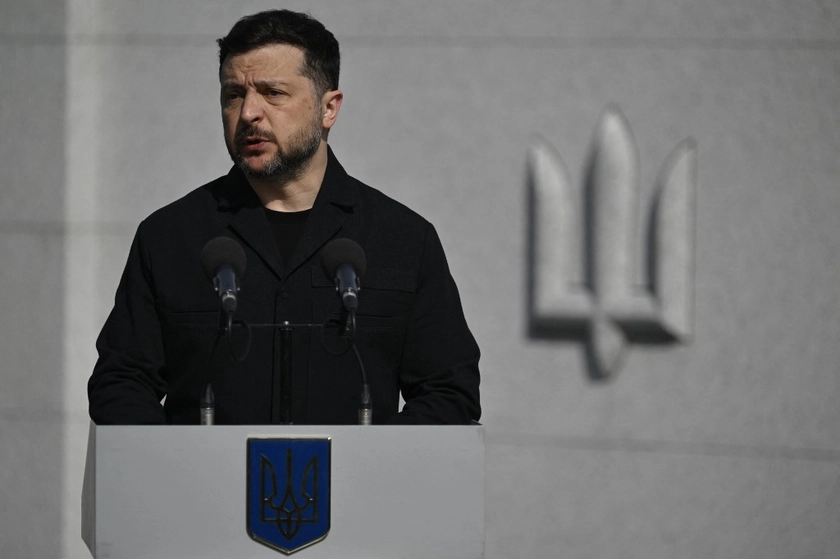
In a statement released on social media, President Zelensky praised the military’s expanding reach.
“There are good results from our warriors in applying long-range sanctions against important targets on the territory of Russia and the temporarily occupied territories of Ukraine,” Zelensky wrote. “More than 700 kilometers from our state border.”
The president detailed that the coordinated overnight assault achieved direct hits on two primary targets essential to the Russian war machine: the “Temp” oil depot and the “Azot” chemical plant.
The widespread drone wave caused disruptions across Russia, triggering air raid alerts in 28 regions and forcing civil aviation authorities to restrict air traffic at six airports.
Striking the “Temp” state reserve
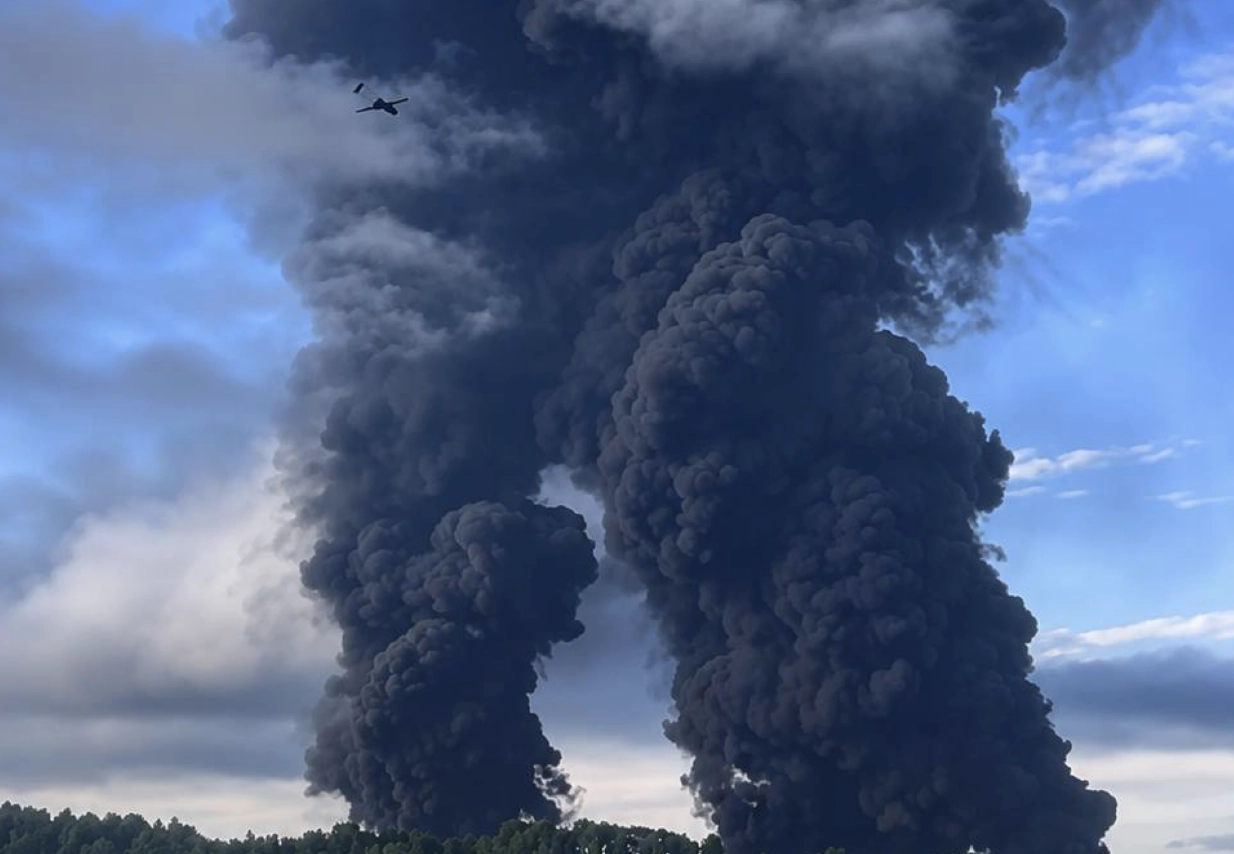
Operators from the SBU’s elite “Alpha” Special Operations Center guided loitering munitions into the Rosrezerv “Temp” oil depot, located in the city of Rybinsk (Yaroslavl region).
Integrated directly into Russia’s state material reserve system, the “Temp” facility is a heavily guarded strategic asset used to stockpile massive quantities of gasoline, diesel fuel, and lubricants. It serves as a primary fuel artery for Russia’s northeastern regions and acts as a strategic staging ground for supplying the occupation army.
Russia Disguises Fuel Trucks as Milk Tankers to Reach Crimea
According to SBU officials, the drone impacts bypassed local defenses and initiated a major industrial fire. Current damage assessments have identified at least three large focal points of combustion within the facility’s main reservoir park, which houses more than 60 bulk storage tanks.
“Russian petroleum storage depots, refineries, and logistics infrastructure remain legitimate targets for the SBU,” the agency stated. “It is these facilities that provide resources to the aggressor’s army and allow the Kremlin to continue its war against Ukraine.”
Expanding on Zelensky’s mention of hits within the temporarily occupied territories, the General Staff of the Armed Forces of Ukraine (AFU) released a operational update on Telegram, detailing a systematic dismantling of Russian tactical logistics and command nodes over the past 24 hours.
Ukrainian forces obliterated a Russian command and observation post near Niekislytsi in Russia’s Bryansk region. Additionally, UAV control centers were successfully struck in Hola Prystan (Kherson region) and Kleban-Byk (Donetsk region).
In the Luhansk region, a specialized workshop used for manufacturing and arming heavy enemy drones was destroyed near Sokologirsk. In the Donetsk region, strikes wiped out a field artillery depot near Pryazovske and a critical logistics warehouse in Kleban-Byk.
Precision strikes decimated Russian troop groupings across multiple sectors, including Vovchansk (Kharkiv region), Zherebianky (Zaporizhzhia region), and Troiebortne (Bryansk region, Russia).
Battle damage assessment for the “Tamanneftegas” terminal
The General Staff also released a highly anticipated Battle Damage Assessment (BDA) regarding the massive June 13 joint operation against the “Tamanneftegas” marine terminal in the Krasnodar Krai.
Located near the settlement of Volna, the terminal is one of the Russia’s vital export facilities in the Black Sea region, possessing the capacity to transship up to 20 million tons of oil and petroleum products annually.
Three massive RVS-40000 type storage tanks (each capable of holding 40,000 cubic meters of fuel) were confirmed damaged or destroyed.
The drone wave severed primary transit pipelines and crippled the high-tech marine loading arms situated on operational Piers No. 5 and No. 6.
Crippling the explosives supply chain
Simultaneously, the strike wave compromised the “Azot” chemical plant in Novomoskovsk (Tula Oblast). While local Governor Dmitry Milyaev initially attempted to downplay the incident by claiming that “drone fragments” fell onto an unnamed industrial enterprise, visual evidence and Zelensky’s confirmation proved otherwise.
As one of Russia’s largest chemical enterprises, “Azot” is indispensable to the Kremlin’s artillery shell production. The facility manufactures ammonia, nitric acid, and methanol – chemical precursors required to synthesize the high explosives packed into Russian ammunition.
A broader logistics lockdown
President Zelensky also confirmed that parallel strikes hit enemy military logistics hubs within the temporarily occupied territories of Ukraine.
This weekend’s multi-region bombardment represents an expansion of Ukraine’s strategy to degrade Russia’s industrial and logistical capabilities before reinforcements and supplies can reach the front lines.
The operations in Tula and Yaroslavl seamlessly follow a highly destructive joint operation by the SBU, HUR, and SSO against the Tamanneftegas marine terminal in Krasnodar Krai, which knocked out southern Russia’s largest hydrocarbon export hub.
You can also highlight the text and press Ctrl + Enter